
At St Augustine’s our aim is to develop motivated and confident children who are resilient in mathematics. We follow the National Curriculum in delivering and our inclusive approach of teaching maths for mastery with an emphasis on thinking deeply about maths allows for more children to have a secure understanding of mathematical concepts thus allowing them to gain proficiency.
As a school community, it is our intent to provide a maths curriculum which allows our children to:
- Engage in mathematical thinking
- Receive daily instruction which is systematic and clear
- Work in an environment which is conducive to learning
- Make progress and become fluent mathematicians
- Make connections day to day, class to class and year to year
- Communicate their understanding through written and verbal tasks in whole group, small group and independent work
- Develop fluency and achieve success through continued practice and opportunities for overlearning
- Do maths with their parents and carers
We believe that all children should be given the opportunity to explore a task and find patterns, make connections and engage in discourse and develop knowledge of facts, formulae, methods and strategies. This begins in EYFS as we ensure that maths is part of children’s daily diet. We give the children a wide range of experiences and opportunities to apply their mathematics including have children draw their maths and work with different representations. During our maths time, through Power Maths lessons and Mastering Number sessions, teachers plan for and deliver teaching that has an appropriate balance of exploration in small groups, direct teaching and independent work.
Engage in mathematical thinking
- Children start each maths lesson with a discover question, in which they have opportunities to explore, question themselves and each other, work systematically, visualise, explain their understanding, make generalisations and justify their approach. During the exploration part of the lesson, teachers facilitate the learning through prompts, specific questioning and providing specific structures as needed. Using the Power Maths scheme, supplemented where needed, teachers ensure children are given a variety of question prompts.
- The Concrete-Pictorial-Abstract approach is embedded in our maths lessons, encouraging all children to see the structure of maths and be able to talk about maths. We recognise the CPA approach is a connected model, with language being at the centre.
- At St Augustine’s, another important aspect to our maths lessons that allow children to show their ability to think mathematically, is journaling. Children complete journals around the “Discover” question around twice a week (according to the lessons taught.) The structure of the journal encourages children to identify the question being asked, show multiple ways of approaching the answer, explain their understanding and write an answer sentence that clearly answers what is being asked. In these journals we encourage children to describe, explain, convince, justify and generalise.
- While planning, teachers consider those children that may have difficulty accessing the lesson, and plan suitable alternate activities if needed. These activities are aimed to provide children with scaffolds, opportunities to overlearn or opportunities to further work with concrete material so that they can still show their understanding through independent practice and be challenged at an appropriate level.
- In pupil voice, one Y2 child commented, "A fact about maths is it just isn’t about getting the answer. It is about thinking with your brain." This is the mindset we aim to create in alll children.
Receive daily instruction which is systematic and clear
- Teachers receive CPD throughout the year to share best practices for teaching maths that are then applied in their classrooms. Through CPD facilitated by both the local Maths Hub and the Mastery Specialist at school, teachers are keen to develop their understanding of the Five Big Ideas and how they relate to the teaching of mathematics.
- Teachers are consistent in methods used, and this is supported through the Power Maths and Mastering Number schemes.
- Teachers use live modelling and organise the structure of lessons to help prevent cognitive overload.
- Teachers model the correct use of maths language and ensure that children practice using maths vocabulary too.
Work in an environment which is conducive to learning
- Children in maths classes at St Augustine’s are happy to take risks as learners and share their thoughts as they know that all maths talk is valued.
- There is a balance of whole class teaching, partner work, small group work as well as a time for independent work.
- Children recognise that we all have different gifts and talents, strengths and weakness. Children respect that sometimes others or themselves may need additional help through the form of small group instruction, small step activities or interventions.
- Due to the common structure of lessons of maths across the school, children know what is expected of them in maths lessons and behave well in maths lessons.
- All children are held to high standards for behaviour as well as work, including presentation.
Make progress
- Through quality first teaching, all children are expected to make progress, regardless of their starting point.
- The practice books provide questions that vary in one small element to move children on in their thinking. They are suitable for most children but we recognise at St Augustine’s that some pupils may need extra help to access this whereas others may benefit from an extension activity.
- To ensure progress is made by all children, maths interventions are planned based on needs noted in class as well as those on our formal assessments. Most interventions are led by teaching assistants, which is why they are present for maths CPD sessions and receive coaching when needed.
- Teachers meet with members of SLT each term to discuss maths progress of all children. During these meetings teachers discuss the impact of previous interventions and any specific concerns.
Make connections day to day, class to class and year to year
- Power Maths’ cohesive approach builds on each concept in small, progressive steps, enabling children to build on prior learning.
- One child confidently stated, "We have resources that help us think and get from one thing to the next thing." (Y4)
- Children participate in KS1 Mastering Number session, Year 3 Mastering Number and KS2 Mastering Number sessions.
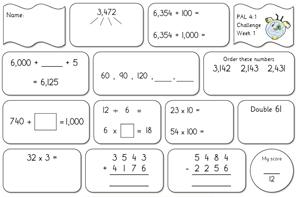
- Fluency sessions include reviewing children’s PALs, which are completed each morning. The PAL stands for Practice and Learn, and includes a set of problems for 12 weeks which vary only slightly, allowing children repeated practice. An example of a PAL is below:
- PALs and set homework provide a spiral review of the content throughout the year.
- Children are encouraged to apply their understanding of maths in real world situations that arise across the curriculum, such as in D&T, PSHE and Science.
Communicate their understanding through written and verbal tasks in whole group, small group and independent work
- During the “Discover” part of the lesson in which children work with a partner, they are expected to explain their thoughts as they work and question each other accordingly. They are encouraged to show their understanding in a variety of ways, or methods, and look for connections between the methods.
- While sharing as a whole group, mistakes are treated as an opportunity to learn.
- All independent work, but especially journals and the Reflect tasks, allow teachers to identify children that may have misconceptions or have difficulties communicating their understanding in a written manner.
Develop fluency and achieve success through continued practice and opportunities for overlearning
- During the maths lesson, opportunities are created by the teacher to provide small group support to those that may need additional teaching. This may be delivered by the teaching assistant or teacher. In response to this additional teaching, it is hoped that children can then work independently on the task given to them.
- All children in EYFS to Year 6 (for the 2026-27 Academic Year) are participating in the Mastery Number Programme. This allows children develop solid number sense, flexibility with numbers, and factual fluency so children move from relying on counting to efficient calculation.
- At St Augustine's we recognise the importance of having a secure knowledge of multiplication facts. Because of this, there is dedicated time to practising multiplication facts in KS2, with this continuing beyond the MTC in Year 4.
Do maths with their parents and carers
- Parents are invited into school during school time to join in maths activities with their children, which are lead by the maths lead alongside their child's teacher. During the meetings, parents join their children and engage in a variety of games which can then be reciprocated at home. Feedback from the meetings is positive. For example, one comment was as follows:

Dates for the 2026-27 Academic Year are as follows:
Friday 6th November - Y6 Maths Parent Workshop 2:15-3:10 KS2 Hall
Friday 13th November - Y4 Maths Parent Workshop 2:15-3:10 KS2 Hall
Friday 20th November - Y2 Maths Parent Workshop 2:15-3:10 KS2 Hall
Friday 27th November - Y1 Maths Parent Workshop 2:15-3:10 KS2 Hall
Friday 4th December - Y3 Maths Parent Workshop 2:15-3:10 KS2 Hall
Friday 11th December - Y5 Maths Parent Workshop 2:15-3:10 KS2 Hall
Friday 8th January - EYFS Parent Workshop 2:15-3:10 KS2 Hall